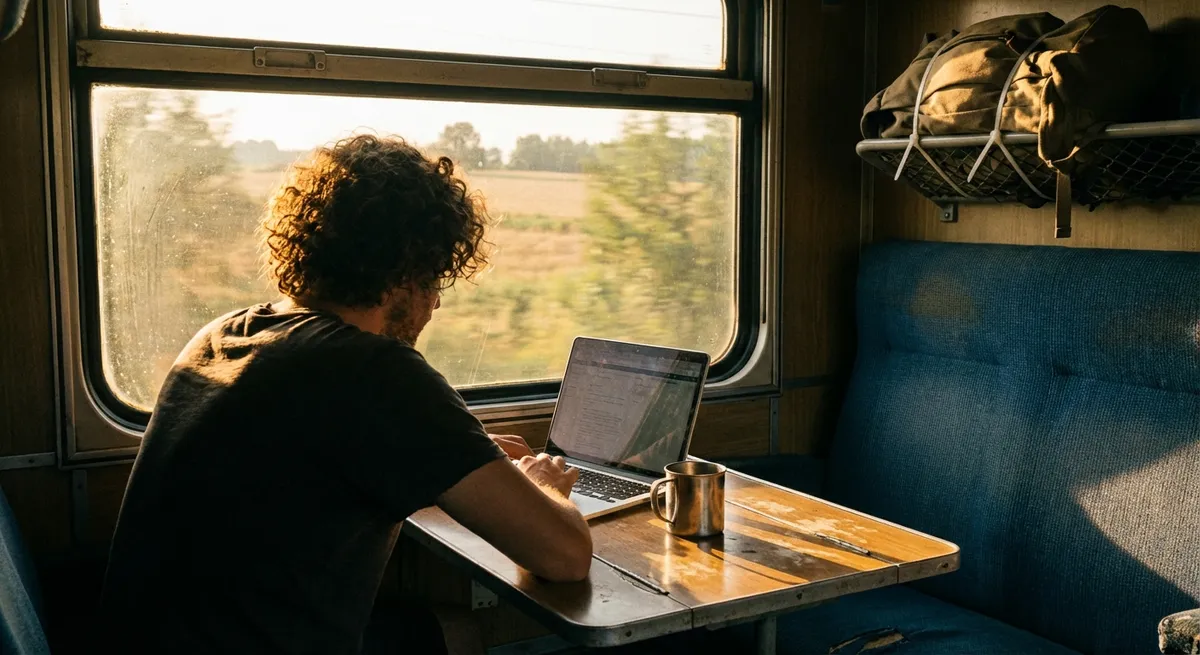
Most nomads obsess over flights, points, and pretty coworking spaces. The ones who actually last focus on something less glamorous: stability while everything around them changes. After a few years of working from buses, budget airlines, and Airbnb roulette, you start to see what really matters.
These are five field-tested habits that keep your work reliable, your stress low, and your trips sustainable—without turning into a full-time logistics manager.
Build a “Travel Mode” Work Routine You Can Run Anywhere
If your routine changes every time your location changes, your productivity will die a slow, painful death.
Create one simple “travel mode” routine that works in almost any city, then tweak it by 10–20% instead of reinventing it every time.
Practical ways to do this:
- Anchor your day around two non-negotiable work blocks (for example, 9–12 and 3–6 in the local time zone), and let sightseeing fit around that—not the other way around.
- Use a single calendar in your home time zone and add a world clock widget for clients. Convert time zones once and stop second-guessing yourself.
- Keep a standard workday checklist in a notes app: deep work, communication, admin, movement, planning tomorrow. In chaotic cities or after long travel days, this list keeps you from drifting.
- Choose one “default” way of working: maybe noise-cancelling headphones + focus playlist + a specific browser profile just for work. When you switch into this setup, your brain knows it’s go time, whether you’re in Bogotá or Bangkok.
- Build in a short “land and stabilize” protocol when you arrive: unpack work gear, check Wi‑Fi, test a video call, buy water and snacks, pin key locations (grocery, pharmacy, workspace) in your map. Work comes much easier once the basics are calm.
Your goal isn’t the perfect routine for each place. Your goal is one solid routine that survives jet lag, sketchy Wi‑Fi, and paper-thin Airbnb walls.
Treat Connectivity Like Rent, Not a Nice-to-Have
Digital nomads don’t just prefer internet; we stop earning money without it. Treat connectivity like rent: non-negotiable, checked in advance, and worth paying more for.
Before you book or commit:
- Check coverage maps, not just vibes. Look up the local networks (e.g., Vodafone, Orange, Telkomsel) and verify 4G/5G coverage where you’re staying, not just “in the city.” Rural beach town ≠ reliable signal.
- Message your accommodation: ask for a screenshot of a speed test at the exact room or desk you’ll use. Upload speed matters as much as download if you’re on calls.
- Always carry two backup options:
- Local eSIM or SIM on a different network than the Wi‑Fi in your apartment or hotel.
- Portable hotspot or a phone you can tether from, with a generous data plan.
- Save offline fallbacks: key docs in offline mode (Google Docs/Drive), maps downloaded in Google Maps, and a local copy of this week’s work so you can still produce when the internet dies mid-day.
- Scout backup work locations on day one: a coworking space and at least one café with outlets and decent reviews for Wi‑Fi. Pin them on your map.
When in doubt, pay extra for more stable internet and central locations. Cheap rent is pointless if you spend half your time hunting signal and apologizing for frozen Zoom calls.
Design a Compact “Work Core” That Fits in One Small Bag
Your real “office” isn’t your Airbnb desk; it’s the gear you can pull out in five minutes and be fully operational anywhere.
Build a tight “work core” that always lives in one small backpack or tech sling:
- Dedicated tech pouch with: laptop charger, phone cable, USB‑C cable, universal adapter, and one multi-port USB charger. Don’t spread these across random packing cubes; they never stay organized.
- Noise control: either noise-cancelling headphones or good foam earplugs. You’ll thank yourself the first time your neighbor throws a midnight karaoke party.
- Physical redundancy for small but critical items: spare USB‑C cable, second pair of headphones (even cheap wired ones), extra SIM tool or paperclip, backup pen. These are the things that break when you’re hours from a store.
- Minimal security layer:
- A simple cable lock to attach your laptop to a table in cafés or hostels.
- A privacy screen if you work with sensitive data in public places.
- Offline work kit: small notebook and pen for outlining, planning, or thinking when your battery is low or you’re in transit.
The test: if your checked bag disappears or your Airbnb isn’t ready, can you walk into the nearest café and do a normal workday with just this one bag? If not, simplify until you can.
Plan Travel Around Energy, Not Just Price
Most people plan routes around cheap flights and dream destinations. Long-term nomads quietly plan around energy and recovery.
Before you click “book” on that overnight connection with two layovers, ask: what does this do to the next three workdays?
Practical filters to use:
- No important calls within 24 hours of arrival when you’re crossing more than three time zones. Your brain will be foggy, your internet uncertain, and your background probably chaotic.
- When possible, aim for daytime flights that land before evening. Evening arrivals plus long immigration lines equal poor sleep and a late start the next day.
- Build one low-output day after each major transit day. Use it for admin, email cleanup, or planning instead of deep work. You’re not lazy; you’re managing your energy like a pro.
- Consider weekly rhythm: heavy travel on Tuesdays or Wednesdays, not Fridays or Mondays, so you’re not wrecking the bookends of your workweek.
- Give “dream cities” realistic timelines. Fast-paced cities (e.g., New York, Tokyo, Mexico City) can drain your energy if you try to “see everything” while working full-time. Commit to either:
- A slower pace and accept you’ll miss some sights, or
- A true vacation week with minimal work.
Your calendar should protect your energy as much as your income. If a cheap flight destroys your productivity for a week, it wasn’t cheap.
Make Local Life Frictionless Within 48 Hours
The sooner a new place feels normal, the more mental bandwidth you get back for work and enjoyment. Aim to reduce local friction aggressively in your first two days.
A simple landing process:
- Day 0 / Arrival
- Buy a local SIM or activate eSIM at the airport if prices are reasonable; otherwise, hit a major mall or carrier store the next day.
- Get cash from an ATM, not currency exchangers in the most touristy spots.
- Stop at a supermarket, not a mini-mart, for basics: water, snacks, breakfast items, coffee/tea, and maybe a simple lunch you can eat while working.
- Day 1 / Setup Day
- Walk your immediate neighborhood: find the nearest grocery, pharmacy, coworking space, and at least two viable cafés. Pin all in your map.
- Test your full work setup: join a fake video call, upload a file, share your screen, and confirm everything works from your main workspace.
- Learn one reliable way home (by foot or public transport) from your workspace or city center before dark. Get this muscle memory in early.
- Day 2 / Local Comfort
- Figure out how locals move: transit card, ride-hailing apps, or motorbike taxis. Download apps and register before you’re stranded.
- Learn three essential phrases (hello/thank you/sorry) and how to read basic signs if the alphabet is different. This reduces friction and makes everyday interactions smoother.
- Bookmark local essentials: hospital/clinic, embassy or consulate, and any emergency numbers in your notes app.
Your target: by the end of day two, nothing basic—food, transport, workspace, connectivity—should require much thought. Once daily life is smooth, you can actually enjoy the things you flew there for.
Conclusion
Sustainable nomad life isn’t about hacking airline algorithms or finding the cheapest hostel. It’s about building systems that hold up when your plans, surroundings, and time zones keep changing.
If you can:
- run the same simple work routine anywhere,
- treat connectivity as a core bill,
- operate from one compact work bag,
- plan travel around your energy,
- and make local life feel normal within 48 hours,
then it stops feeling like you’re “barely holding it together” in a new country every month. You’re not just traveling—you’re running a stable, mobile life that happens to cross borders.
Sources
- U.S. Federal Communications Commission – International Roaming Tips - Practical guidance on mobile data, roaming, and avoiding surprise charges while abroad
- GSMA Mobile Coverage Maps - Interactive maps showing mobile network coverage worldwide, useful for checking connectivity before choosing destinations
- CDC – Travelers’ Health - Official health advice, destination-specific guidance, and preparation checklists for international travel
- U.S. Department of State – Country Information - Security, entry requirements, and emergency contact info for countries around the world
- Harvard Business Review – How to Make the Most of Working Remotely - Research-based tips for building productive remote work routines that apply well to digital nomads
Key Takeaway
The most important thing to remember from this article is that this information can change how you think about Travel Tips.