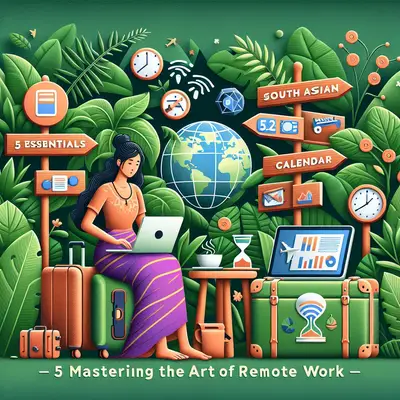
If you’ve ever tried sending a proposal from a beach bar with “Wi-Fi” that barely loads email, you already know: the Instagram version of remote work is a lie. Real nomad life is less hammock, more finding a quiet corner with stable internet before your client call in 20 minutes. This guide is for the working nomad who has deliverables, not just postcards—5 essential, field-tested practices that keep your income steady while everything else moves.
Build a Workable Base Before You Move Your Body
Most nomads flip this: they pick a city, book a flight, then try to wrestle their work into whatever chaos awaits. The pros quietly do the reverse—they build a stable work base that travels with them.
Before you change locations, lock in three non-negotiables: your core work hours, your primary workspace setup, and your connectivity plan. Core hours mean you decide when you’re reliably online for clients, teammates, or customers, even if that means early mornings or late nights to match time zones. Your workspace setup doesn’t need to be fancy, but it should be replicable: laptop stand or random books, cheap USB keyboard, mouse, noise-cancelling headphones, and a way to block visual clutter (even a simple cap or hoodie helps in noisy hostels).
Connectivity is where most nomads get burned. Don’t trust a single connection. In cities, you want at least three options: local SIM with a decent data package, Wi-Fi at your accommodation, and a known backup spot (co-working, reliable café, or public library). In more remote places, assume the connection is worse than advertised and plan bandwidth-heavy tasks (uploads, big calls) around that reality. Once this base is dialed in, every new city becomes a variable—not a crisis.
Treat Time Zones Like a System, Not a Surprise
The amateur approach is constantly complaining about time zones; the professional approach is designing around them. Your calendar should reflect all relevant time zones automatically. Use a digital calendar that can display multiple time zones side by side, and set your “home” zone to where most work happens (often US/EU), not where your body currently is.
Design your days around energy and overlap. Figure out your highest-focus window in the local day (for deep work) and the overlap window where you’re reachable for calls or Slack. Protect those blocks like revenue: no transit, no sightseeing, no check-ins. When you move time zones, intentionally reset the system: audit your recurring meetings, renegotiate call times ahead of the move, and add clear time-zone labels to any client- or team-facing links.
Communicate your availability like a pro. Put a simple, up-to-date “working hours & response window” note in your email signature, Slack status, and onboarding docs for any new client. If you’re moving or on a long travel day, pre-warn people at least 48 hours ahead and offer alternatives: “I’ll be in transit on Thursday; if we need something time-sensitive, let’s lock it in Wednesday or move to Monday.” You’re not trying to be always-on; you’re trying to be predictably on.
Make Money Flow Predictable Before Life Gets Interesting
Nomads don’t quit over beaches or visas; they quit when the money rollercoaster becomes too stressful. The game is not “maximum revenue” at all times—it’s “reliably enough income to keep playing.” That starts with smoothing cash flow.
Lock in at least one stable income stream before you start stacking experiments. This might be a long-term client, a part-time remote contract, a recurring retainer, or a predictable set of deliverables each month. The form matters less than the predictability. If you freelance, push for retainers or ongoing agreements instead of only one-off projects. If you’re employed, clearly document expectations: KPIs, communication norms, and output so no one is guessing whether you’re working.
On the logistics side, set up your financial infrastructure to work from anywhere: international-friendly bank accounts, low-fee cards, and a primary invoicing/payment tool clients are comfortable with. Time-shift your billing habits—invoice early, not late, because transfers and payment hiccups are magnified when you’re juggling visas and accommodation. Your future self in some random Airbnb with a broken AC will be grateful you didn’t wait until “later this week” to send invoices.
Design a “Travel Mode” Workflow So Work Doesn’t Collapse
The riskiest time for remote work isn’t a normal Tuesday in Lisbon. It’s the 24–72 hours around moving days: flights, buses, border crossings, jet lag, lost bags, early check-outs, late check-ins. This is when deadlines die—unless you build a “travel mode” version of your work.
Travel mode means you deliberately downgrade your commitments for that window. In practice: no critical deadlines within 24–48 hours of major moves, no first-time client calls on a transit day, and no big live sessions or launches right after you land in a drastically new time zone. Instead, stack low-risk tasks for those windows: admin, light writing, email cleanup, planning, or training videos.
Technically, prepare like your internet will vanish. Sync necessary docs offline, download key files, and have local backups for anything critical. Keep a small “work essentials” kit in your personal bag—laptop, chargers, adapters, basic peripherals—so even if luggage disappears, you can still function. If you know a move might disrupt work, warn clients early: “I’m changing locations on Friday; I’ll front-load work earlier in the week and may be slower to respond that day.” You’re not apologizing for travel; you’re managing risk like a responsible partner.
Protect Your Focus Like It’s Part of Your Job (Because It Is)
The biggest productivity killer isn’t the new city—it’s the constant novelty. New food, new people, new noise, new problems. If you don’t structure your focus, your attention will atomize and your output will slide, slowly enough that you don’t notice until a client calls you out.
Start with a daily non-negotiable work window, even if it’s short. For some, that’s 3–4 deep-focus hours first thing in the morning before you touch anything social or touristy. For others, it’s evening after the city quiets down. Anchor that block with a ritual: same café, same playlist, same routine. Your brain needs a repeated signal that “now we work,” even when the scenery keeps changing.
Decide how you’ll deal with distractions in advance. For noisy places, noise-cancelling headphones and one or two focus playlists you always use. For social distractions, be honest with new friends and hostel mates: “I disappear from 8–12 for work; I’m around after that.” For digital noise, turn off non-essential notifications and keep your work apps separate from personal ones (even separate browser profiles or devices if you can). At the end of each day, write a 3–5 bullet list of the next day’s top tasks—so when you sit down in a new spot tomorrow, you don’t waste your freshest energy deciding what matters.
Conclusion
Remote work on the road isn’t about squeezing tasks between sunsets; it’s about building a portable system that survives flight delays, visa runs, and flaky Wi-Fi. When you treat time zones like architecture, cash flow like stability, travel days like risk, and focus like a core skill, your location stops being the problem and becomes just another variable.
The nomads who last aren’t the ones with the best photos; they’re the ones whose clients barely notice they’re moving at all—except when they ask, “Wait, where are you now?” If you can answer that question without your income shaking, you’re doing it right.
Sources
- Harvard Business Review – How to Collaborate Effectively If Your Team Is Remote - Practical guidance on communication, expectations, and workflows for remote teams
- Buffer – State of Remote Work - Annual research on remote work trends, challenges, and best practices from thousands of remote workers
- World Bank – Remittance Prices Worldwide - Data and insights on cross-border payment costs, relevant for choosing payment methods as a nomad
- US Federal Communications Commission – Broadband Speed Guide - Official recommendations for bandwidth needs for video calls and online work
- University of California, Berkeley – Guide to Managing Remote Workers - Evidence-based advice on expectations, performance, and communication in remote setups
Key Takeaway
The most important thing to remember from this article is that this information can change how you think about Remote Work.