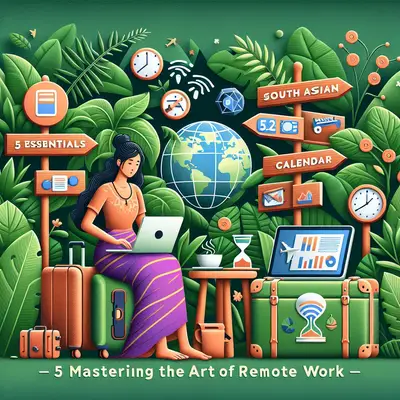
Remote work looks glamorous in photos: laptop, beach, coconut. In real life, it’s more like: spotty Wi‑Fi, client calls at 11 p.m., and trying to find a quiet corner in a hostel where no one’s blending a smoothie. This isn’t about the Instagram version of being a digital nomad. It’s about building a setup that holds up under pressure so you can keep earning, keep moving, and not burn out in six months.
Below are five field-tested principles that separate “short-term adventure” from a sustainable remote work life. None of them are flashy. All of them are what actually keep you employable and sane on the road.
1. Treat Your Time Zones Like Infrastructure, Not an Afterthought
If you wing time zones, your work life will own you. The more borders you cross, the more your calendar becomes a liability unless you design around it.
Start by locking in your “non‑negotiable overlap” with clients or your team. That might be 2–4 hours per day where you’re consistently available. Plan your moves around that band, not the other way around. Jumping from Lisbon to Bali overnight might look fun, but going from a 3‑hour to a 10‑hour difference can wreck your workflow for weeks.
Use a primary time zone in your calendar and stick to it publicly. For example, keep everything in UTC or your client’s time zone, and let your tools do the conversion. Apps like Google Calendar, Calendly, and tools like World Time Buddy help, but they only work if you commit to a system and don’t improvise every time someone says, “Let’s talk Thursday.”
Before you book a long-haul flight, ask three questions:
- What meetings fall within 24 hours of my travel?
- Will I be jet-lagged and coherent for any important calls?
- Can I pad in 24–48 hours of light workload after arrival?
The remote worker who can move across three time zones and still show up sharp for Monday’s standup is the one clients keep.
2. Make Your Work Environment Portable (Not Perfect)
You will never have a perfect workspace on the road. Your goal isn’t perfection; it’s a reliable “good enough” setup you can deploy almost anywhere in 10 minutes.
Build a minimal kit you actually carry every day, not a fantasy stack that stays in your suitcase:
- Lightweight laptop stand so you’re not hunched over hostel tables.
- Compact external mouse and keyboard for full‑day work sessions.
- Noise‑canceling or at least noise‑isolating headphones—these are your office walls.
- A short power strip or travel extension with multiple outlets and a universal adapter.
- A webcam cover or external webcam if you’re often in dark, awkward corners.
When you land somewhere new, your first priority isn’t the beach; it’s testing your “office options”: coworking spaces, quiet cafés, hotel lobby corners, or even a park with strong data and shade. Take one afternoon and stress‑test them: video call, upload/download a large file, and check how you feel after 90 minutes there.
Expect that some days you’ll work from a kitchen table with people cooking around you. That’s fine if you’ve already got noise control, ergonomic basics, and backup connectivity handled. The professional difference isn’t where you work—it’s how quickly you can adapt your setup so your output doesn’t tank every time your location changes.
3. Build Redundant Connectivity Like Your Income Depends on It (Because It Does)
If all your work depends on “the hostel Wi‑Fi seems fine,” you don’t have remote freedom; you have a single point of failure. The people who last as digital nomads think like network engineers: assume things will break and build workarounds in advance.
Wherever you go, you should have at least two, ideally three, ways to get online:
- Primary: stable Wi‑Fi (coworking, apartment, or solid café connection).
- Secondary: local SIM card with a generous data plan or eSIM.
- Tertiary: offline workflows for when both of those fail.
Before you sign a long‑stay rental, ask for a speed test screenshot (up and down) and the router location. In rural or developing areas, ask whether there are frequent power cuts and if there’s a generator. “Fast internet” in a listing often just means “it loads Netflix.”
Maintain a simple “offline work pipeline.” For example:
- Draft proposals, articles, or code locally in tools that sync later (text editors, offline docs).
- Keep key docs and project notes synced offline via apps like Notion, Obsidian, or Google Docs offline mode.
- Batch heavy uploads (video files, large backups) for known good connections, like coworking spaces.
The nomads who never miss deadlines are usually the ones who planned for outages before they happened.
4. Set Boundaries That Survive Different Countries and Cultures
Travel will constantly tempt you to break your own rules—late nights, spontaneous trips, “just one more drink” the night before client calls. That’s where remote careers go to die. The job isn’t to say no to everything; it’s to set a few guardrails that survive country changes, roommates, and shifting schedules.
Design a default workday template that you can apply almost anywhere: start time, deep work block, meeting hours, admin time, and a hard stop. You’ll have to bend it sometimes for time zones, but you should know what “normal” looks like for you.
Translate that into clear communication:
- Tell clients your standard response times and what “urgent” actually means.
- Use status messages in Slack, Teams, or email (“I’m offline after 7 p.m. your time; urgent issues call/text”).
- Let travel companions know your work windows so you’re not renegotiating daily.
Boundaries aren’t about being rigid—they’re about avoiding constant decision fatigue. If your rule is “no new work calls after 7 p.m. client time,” you don’t debate it every time a request comes in. You either decline, reschedule, or make it a rare, conscious exception.
Most importantly, guard your recovery. Sleep gets hammered by time zones, night buses, and cheap flights. Prioritize sleep the way you prioritize your laptop: without it, nothing works. A boring night in with a proper 8 hours will do more for your long‑term remote career than one more “epic” bar crawl.
5. Manage Your Reputation Like It’s Your Only Real Asset
Remote workers don’t have office politics, but they do have something more fragile: reputation at a distance. No one sees how hard you’re trying—they see whether you deliver when you say you will. On the road, that’s harder than it sounds.
Start with reliability over brilliance. Hit deadlines consistently, even if that means under‑promising on scope or timelines. If travel disrupts you, communicate earlier than you think is necessary:
- Notify clients before you move countries, not after you land.
- Flag potential delays while you can still adjust, not the night something is due.
- Offer solutions when there’s a problem: “Here’s what happened, here’s how I’m fixing it, here’s what you can expect from me this week.”
Document your work more than you would in an office. Share brief weekly updates: what you shipped, what you’re working on next, and anything that might block progress. This builds trust and makes your location less relevant in people’s minds.
Also, be realistic about how “nomadic” you can be for the kind of work you do. If your work requires heavy collaboration or constant real‑time support, give yourself longer stays, stable time zones, and fewer overnight buses. Your brand shouldn’t be “the person who’s always in transit and sometimes available.” It should be “the person who delivers, happens to move a lot, and is weirdly unbothered by it.”
In the end, visas expire, hotspots fail, apartments change—your professional reputation is what follows you across borders.
Conclusion
Remote work isn’t magic; it’s logistics plus discipline. The people who last as digital nomads aren’t the ones with the best photos—they’re the ones who quietly solve for time zones, connectivity, workspace, boundaries, and reputation over and over again.
If you treat those five areas like infrastructure, not afterthoughts, you can move countries without resetting your career every time you land. That’s when remote work stops being a short‑term escape and starts becoming an actual way of life.
Sources
- [U.S. Bureau of Labor Statistics – Job Flexibilities and Work Schedules](https://www.bls.gov/news.release/flex2.toc.htm) – Data on flexible and remote work arrangements and how people structure their time
- [Harvard Business Review – A Guide to Managing Your (Newly) Remote Workers](https://hbr.org/2020/03/a-guide-to-managing-your-newly-remote-workers) – Practical insight into communication, expectations, and trust in remote setups
- [World Health Organization – Sleep and Health](https://www.who.int/news-room/fact-sheets/detail/sleep-and-health) – Why sleep and recovery are critical for sustainable performance, especially across time zones
- [Pew Research Center – COVID-19 Pandemic Continues To Reshape Work in America](https://www.pewresearch.org/social-trends/2023/03/30/how-the-covid-19-pandemic-continues-to-reshape-work-in-america/) – Research on how remote work has evolved and what workers value now
- [Speedtest by Ookla – Global Speed Index](https://www.speedtest.net/global-index) – Country-by-country internet performance data useful for planning remote work destinations
Key Takeaway
The most important thing to remember from this article is that following these steps can lead to great results.