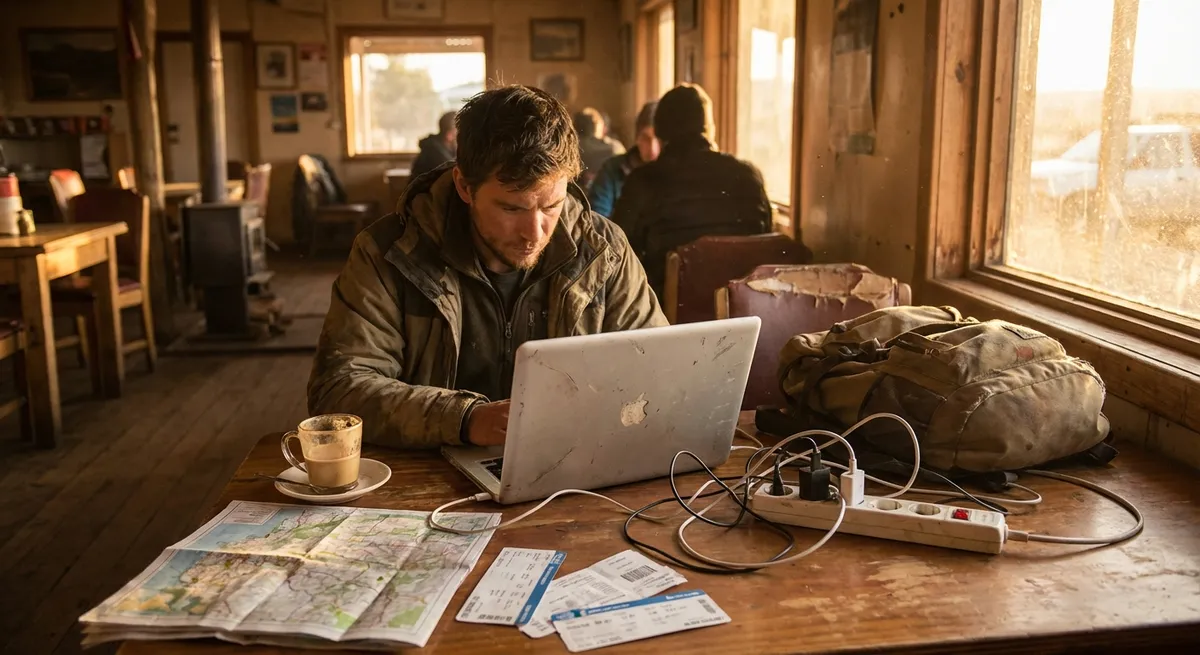
Moving every few weeks while keeping clients happy is not “vacation with a laptop.” It’s a logistics sport. Flights get delayed, Wi-Fi lies, and that cute beach café closes right when your call starts. This guide pulls from hard-earned lessons to help you build a travel routine that doesn’t blow up your workday.
Below are five essential, field-tested travel habits that actually hold up once you’re living on the road—not just passing through.
1. Choose Destinations With a “Workability Check,” Not Just a Bucket List
Most people choose destinations based on photos. Nomads don’t have that luxury—you need places that won’t sabotage your work.
Before you book anything, run a quick “workability check” for each new city:
- Time zone reality check: Don’t just look at the offset. Map your actual working hours against local time. If your main clients are in New York and you’re heading to Southeast Asia, ask: “What time will my latest meeting actually finish?” If it’s pushing midnight every night, you’ll burn out fast.
- Connectivity research beyond ‘Free Wi-Fi’: “Fast Wi-Fi” in listings means nothing. Look for:
- Coworking spaces within 20–30 minutes walking or transit.
- Local SIM providers with eSIM options and data speeds (Google “[city] coworking,” “[country] best eSIM,” plus Reddit search).
- Accommodation reviews that specifically mention video calls, not just “Wi-Fi was fine.”
- Infrastructure for bad days: Are there multiple cafés, coworking spaces, or libraries? If your apartment’s internet dies, you need a Plan B within 15–20 minutes, not a heroic cross-town expedition.
- Long-stay livability: Check basics: walkability, supermarkets, laundromats, safe areas after dark. Poor logistics = wasted time and mental energy that you can’t bill anyone for.
Make it a habit: every new city gets a 30–45 minute research session focused purely on “Can I work here without fighting the environment every day?”
2. Treat Connectivity Like Oxygen, Not a Nice-to-Have
Your income rides on your ability to show up online on time. Don’t assume anything—verify everything.
Before you arrive:
- Book with non-negotiable Wi-Fi clarity:
- “What is the typical download and upload speed (in Mbps)?”
- “Is the router inside the apartment or shared on another floor?”
- “Has anyone worked from the apartment doing video calls?”
Ask the host/property specific questions:
If the answers are vague or evasive, assume the worst and plan a backup.
- Arrive with data ready to go:
Use an eSIM provider or buy a local SIM at the airport for immediate coverage. Even 5–10 GB of high-speed data can save a client call or a deadline when Wi-Fi flakes.
Once you arrive:
- Test, don’t guess:
Within the first hour, run a speed test in the exact spot you plan to work from (use tools like Speedtest or Fast.com). Do test calls with a friend or colleague—audio and video both.
- Build a “connectivity backup stack”:
- Local SIM with hotspot enabled.
- A second work location (coworking space or quiet café with public outlets).
- Offline versions of key tools (documents, notes, reference files synced locally).
Your goal: even if the building Wi-Fi dies completely, you can still join a call and deliver work without panic.
3. Pack for Work, Not Instagram
Most first-time nomads overpack clothes and underpack the small items that actually keep them operational.
Prioritize a “work kit” that always travels in your carry-on:
- Power & stability:
- Universal travel adapter with multiple USB-C and USB-A ports.
- A short extension cord or compact power strip—outlets are often in all the wrong places.
- Surge-protected strip if you’re going to places with unstable power.
- Noise and focus:
- A solid pair of noise-cancelling headphones is worth every cent—hostels, thin walls, and street noise will not respect your meeting schedule.
- A lightweight eye mask if you end up with a bright or noisy room.
- Call-ready setup:
- A backup wired headset or earbuds (Bluetooth fails, batteries die).
- Small, foldable laptop stand to get your camera to eye level.
- Lightweight external mouse/trackpad—tiny tables and long days kill wrists fast.
- Tiny lifesavers you only forget once:
- Extra charging cables (at least one full spare for your phone and laptop).
- Small roll of tape and a couple of binder clips (cable management, makeshift tripod, curtain blackout).
- A SIM ejector tool (or a paperclip taped inside your passport wallet).
Everything above should fit in one small pouch that never leaves your carry-on. Checked luggage can disappear; your ability to work shouldn’t.
4. Design a “Move Day Protocol” So Travel Doesn’t Destroy Your Week
Travel days are where most productivity goes to die. Tired, hungry, and offline is a dangerous combo when clients still expect responses.
Instead of hoping each move goes smoothly, create a simple, repeatable protocol:
48–24 hours before you move:
- Lock down work commitments:
- Avoid booking important calls 12 hours before or after major travel, if possible.
- Let key clients or teammates know your travel window and potential response delays.
- Pre-download everything:
- Offline maps (Google Maps or Maps.me) for your new city.
- Key work files from cloud tools.
- Boarding passes, accommodation details, coworking address.
Day of travel:
- Protect your “critical window”:
- Have enough battery (carry a charged power bank).
- Have some data for emergency hotspot.
- Aren’t in the air or in a dead zone during that window, if you can help it.
- Schedule low-brain tasks:
- Inbox cleanup.
- Admin work, receipts, budgeting.
- Reading, research, or course videos offline.
Decide the 2–3 hours of the day when you absolutely must be reachable (for example, client HQ working hours). Make sure you:
Travel days are good for:
Treat travel like a part-time job that shares your day with your actual work. You’re not going to be at 100%; the goal is to avoid going to 0%.
5. Build Routines That Survive Constant Change
The scenery will change constantly. If your habits depend on specific cafés or your “perfect” workspace, you’ll lose all rhythm the second you move.
Instead, design routines that are location-agnostic:
- Anchor your day with 2–3 non-negotiables:
- 10–20 minutes of movement (walk, stretch, basic bodyweight exercises).
- A set “deep work” block (90–120 minutes) as early in the day as your time zone allows.
- A daily check-in block (email, messages, admin) at fixed times so you’re not glued to notifications.
- Create a fast “workspace setup ritual”:
- Pick a seat with power access and minimal traffic behind you (for video calls).
- Plug everything in, set laptop on stand, connect mouse/keyboard.
- Adjust audio, check background, run a test video preview.
- Fill water bottle, clear the table except for what you need.
For many nomads, this looks like:
Wherever you land, you repeat the same 5–10 minute sequence:
The point isn’t perfection; it’s speed. Within minutes, your brain recognizes, “We’re in work mode now,” no matter which country you’re in.
- Plan around your energy, not just your schedule:
If you’re a morning person but your clients are in a time zone that pushes calls late, don’t waste your high-energy morning on admin. Use it for deep work, then schedule calls when your brain can run on autopilot.
The longer you’re nomadic, the more you’ll see that consistency beats intensity. The habits that feel “too small to matter” are exactly the ones that let you keep moving without falling apart.
Conclusion
Long-term travel plus real work isn’t about hacks—it’s about reducing friction. When your destinations are chosen with “workability” in mind, your connectivity has backups, your gear is dialed in, your move days are structured, and your routines travel with you, the lifestyle stops feeling like a juggling act and starts feeling sustainable.
You won’t control delayed flights, noisy neighbors, or surprise internet outages. But with these five habits baked into your travel routine, those problems become annoyances—not career-threatening crises.
Sources
- U.S. Department of State – Country Information – Official country pages with local conditions, safety info, and entry details helpful when evaluating new destinations.
- International Telecommunication Union – ICT Statistics – Data on internet and broadband penetration by country, useful for judging connectivity expectations.
- Speedtest Global Index – Compares average mobile and fixed broadband speeds worldwide to understand likely internet quality in different locations.
- Centers for Disease Control and Prevention – Travelers’ Health – Health recommendations and advisories to factor into long-stay destination planning.
- Harvard Business Review – How to Make the Most of Your Workday – Research-backed guidance on structuring work time and routines, relevant for designing portable daily habits.
Key Takeaway
The most important thing to remember from this article is that this information can change how you think about Travel Tips.