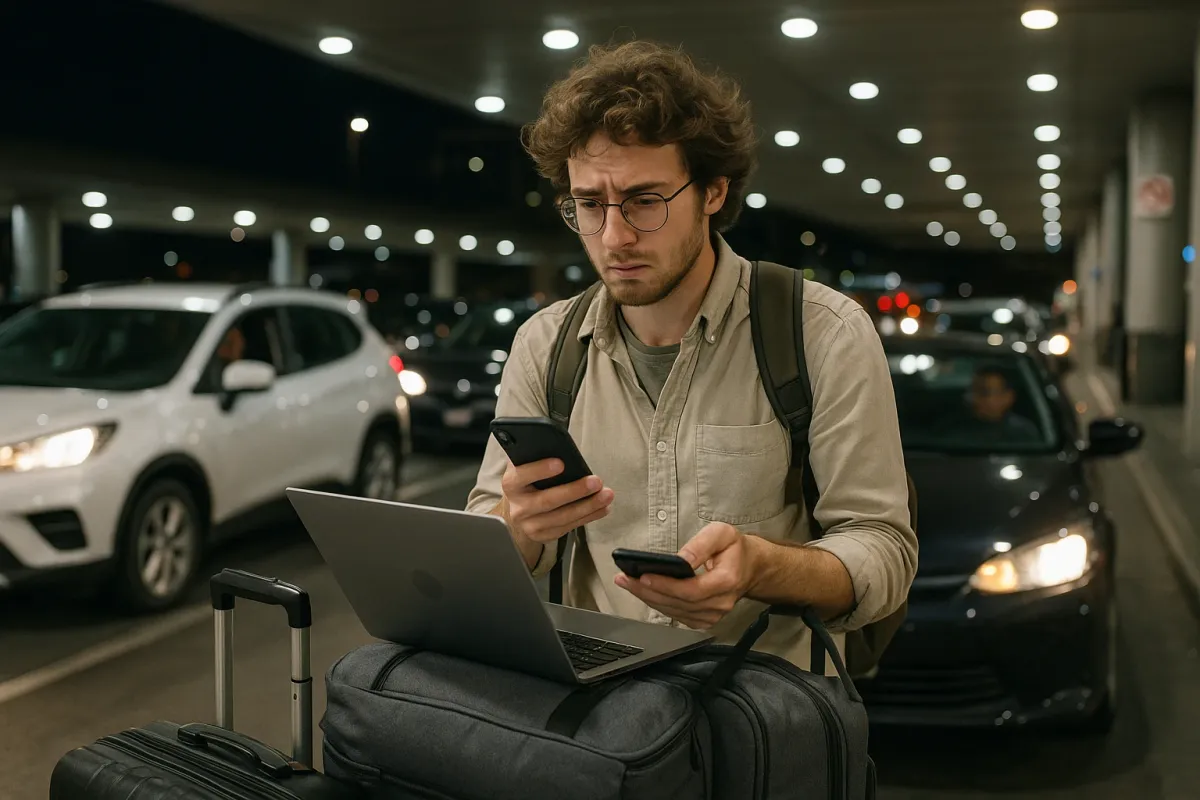
If you spend enough time living out of Airbnbs and co-working spaces, you eventually realize this: your day can be completely derailed by one bad ride. That’s why those “Overheard in Uber” stories that just went viral aren’t just funny—they’re a reminder that for digital nomads, ride-hailing is part of our office infrastructure now. When your “commute” is a Grab in Bangkok, an Uber in Lisbon, or a Bolt in Tbilisi, what happens in that car affects your work, your safety, and your sanity.
A recent Bored Panda feature pulled dozens of wild conversations and awkward moments from an Instagram account that collects “Overheard in Uber” snippets. Behind the laughs is a serious point: nomads increasingly depend on gig-economy transport in cities where we don’t speak the language, don’t know the neighborhoods, and don’t always have a local friend to call. That makes how we use Uber, Lyft, Bolt, Grab, Didi, and inDrive a core nomad skill, not just a convenience.
Below are five field-tested strategies I’ve refined over years of working remotely in ride-hail-dependent cities—from Medellín to Dubai—that will help you stay safer, avoid costly mistakes, and keep your workday on track, even when the backseat drama around you could make it into the next “Overheard” compilation.
Treat Ride-Hailing as Mission-Critical Infrastructure, Not a Luxury
Most nomads still think of Uber and its rivals as “nice-to-have” rather than a key part of their work stack. But in many digital-nomad hubs—Mexico City, Bangkok, Lisbon, Bali—the reliability of your transport directly impacts your earning power. If you’re constantly showing up late to calls because the metro is jammed or the bus never came, your reputation suffers, not the transit authority’s.
In 2025, Uber and Bolt are aggressively expanding in secondary cities and tourist corridors precisely because remote workers and travelers are driving stable demand. That’s good news—but it also means surge pricing and patchy coverage in trending neighborhoods. Treat your ride apps like you treat your internet connection: test, compare, and have backups. Install at least two local favorites (for example, Uber + Didi in Mexico, Grab + Gojek in Southeast Asia, Bolt + FreeNow in parts of Europe). Before committing to a co-working space or long-term stay, do a dry run during your typical call hours and note ride availability and wait times. It’s the same mindset you use for checking Wi‑Fi speeds—just applied to wheels instead of routers.
Use “Passive Safety Habits” Every Single Ride
Those viral “Overheard from Uber” posts focus on the funny, but scroll deep enough and you’ll find the unsettling stuff: drivers oversharing, passengers trapped in weird conversations, rides going off route. Most of the worst situations I’ve seen other nomads get into didn’t start dangerous—they started awkward, and people didn’t know how to reset the dynamic.
Build what I call “passive safety habits”—small behaviors that don’t look paranoid but quietly protect you in almost any city:
- Match plate, model, and driver photo every time before you open the door. No exceptions, even if you’re late for a Zoom call.
- Sit behind the passenger seat, not directly behind the driver; you can see the screen and have more control over exits.
- Keep audio navigation on your phone visible, even if you’re not actively following it—this subtly signals you’re paying attention to the route.
- Use in-app chat instead of giving your number when possible, especially in countries where WhatsApp is standard and drivers may want to “stay in touch.”
- Share your trip status (built into Uber, Lyft, Bolt, Grab) with a trusted friend or “safety buddy” who knows your general schedule.
- Normalize boundaries with one sentence ready: “I’ve got to focus on work messages for a bit, if you don’t mind” works in almost any language with a translation app.
These moves don’t kill the vibe, and you can still have great conversations. They just keep you out of the kind of “plot-twist” stories that end up getting screenshotted for the internet.
Turn Cars into Micro-Workspaces—Without Killing Your Battery or Data
Those “Overheard in Uber” screenshots exist because people are working, arguing, or venting from the backseat. For nomads, cars are often where we handle Slack, approve designs, or jump on quick audio calls between a café and a co-working space. Done right, you can reclaim 1–2 hours of productive time per day just from transit.
Here’s how to use ride time like a pro without burning out your devices or data:
- Plan “car tasks”: Before ordering a ride, mentally queue low-bandwidth tasks—Slack replies, email triage, offline doc editing, voice note planning. Save heavy uploads for stable Wi‑Fi.
- Carry a low-profile power bank and a short cable in an easy-access pocket. Don’t rely on in-car USB ports; in many markets they’re underpowered or nonexistent.
- Download offline maps and documents for the city the day you arrive. If the network drops mid-ride (common in tunnels, mountain roads, or dense cities), you can still work and verify your route.
- *Use noise-cancelling earbuds rather than big over-ears: they’re less conspicuous and let you quickly hear the driver if needed.
- Switch video calls to audio by default in rides. Nomad reality check: in many countries, drivers earn little and may feel filmed or judged if you’re constantly on camera behind them. Audio is more discreet and resilient to network hiccups.
- Keep work conversation vague in transit—those “overheard” accounts prove how easily sensitive info leaks. Don’t pitch deals, quote rates, or share client names out loud when you’re inches from a stranger.
Think of your rides as “Tier‑2 work sessions”: not your best deep-focus output, but perfect for clearing the mental backlog so you hit your accommodation or co-working space ready for the heavyweight tasks.
Learn the Local Ride Culture, Not Just the App Interface
One pattern you’ll notice if you read enough of those “Overheard in Uber” stories: a lot of conflicts come from cultural mismatch, not evil intent. A driver in New York may feel entitled to recap their entire love life. A driver in Dubai may say almost nothing. In Tbilisi, it’s normal to ride up front and chat; in São Paulo, most solo women default to the back with minimal small talk.
As a nomad, understanding these norms is as important as knowing SIM card prices:
- Ask other nomads and locals: In every new city, drop a question in the local WhatsApp/Telegram/Facebook nomad group: “Anything I should know about Uber/Grab/Bolt here?” You’ll get tips ranging from tipping expectations to which neighborhoods are sketchy after dark.
- Check how people handle cash vs. card: In some regions (parts of Africa, Latin America, Southeast Asia), drivers strongly prefer cash or may cancel card trips. In others, cash can be a hassle. Set your payment method accordingly and carry small bills if needed.
- Learn 3–4 “ride phrases” in the local language: “Straight ahead, please,” “I’ll get out here,” “I’m not in a hurry,” and “I’m in a hurry” can dramatically reduce stress and misunderstandings.
- Respect the local risk level: The same Uber ride that feels totally fine in Copenhagen requires more vigilance in parts of Central America or South Africa. Don’t import your comfort level from your last country; recalibrate each time.
- Understand rating etiquette: Drivers in markets with harsh penalties for low ratings may beg you for 5 stars; in others, ratings are more relaxed. A single 1-star in some emerging markets can significantly impact income, so reserve it for truly unsafe situations, not mild awkwardness.
Knowing the culture behind the wheel keeps you from misreading a driver’s behavior—and from becoming the clueless foreigner starring in someone else’s “you won’t believe what my passenger did” story.
Build a Redundancy Plan for When the Apps Fail (Because They Will)
Those curated “Uber conversation” feeds rarely show the most stressful reality: standing on a dark street at 11 p.m. with your phone on 7%, no Wi‑Fi, and the app stuck on “searching for drivers.” As a nomad, you will eventually meet that moment. Planning for it in daylight is what separates the rattled backpacker from the calm long-term traveler.
Here’s how to structure a simple but effective backup plan for each city:
- Save the number of a reputable local taxi dispatch (found via hotel desks, co-working staff, or trusted locals) and store it offline.
- Pin your accommodation, co-working space, and “safe hubs” (24/7 hotels, big malls, police stations) in offline maps. If your driver gets lost or your app fails, you can still navigate or give clear directions.
- Screenshot your booking details (address, host phone, building photo) for new stays. If you arrive late and the app glitches, you’re not guessing a street name from memory.
- Carry a small “last-mile” cash stash in the local currency—enough for a 20–30 minute taxi ride. Keep it separate from your main wallet so a lost card doesn’t kill your mobility.
- Know the nearest public transit spine: even if you don’t plan to use buses/metro daily, understand the main line or route that can get you within walking distance if all else fails.
- If you’re landing late at night, consider pre-booking an airport transfer through your hotel, hostel, or a known service for night one only*, then switch to app rides the next day. You’re fresher, more alert, and better able to troubleshoot in daylight.
Redundancy is unsexy, but it’s exactly what makes the nomad lifestyle feel stable instead of constantly one crisis away from a horror story.
Conclusion
The explosion of “Overheard in Uber” posts is funny because we all recognize ourselves in them: half-working, half-eavesdropping, juggling messages, and trusting strangers to get us across unfamiliar cities. For digital nomads, that’s not just entertainment—it’s a mirror of how we actually live and work in 2025.
If you start treating ride-hailing as core infrastructure, build subtle safety habits into every trip, turn transit into focused micro-work, learn the local ride culture, and keep a simple backup plan when the apps flake out, you’ll gain something precious: predictability in a lifestyle that’s built on change. Your rides stop being random episodes and become a reliable, almost invisible part of your remote-work ecosystem.
And the next time someone overhears you in the back of an Uber, hopefully it’s not a meltdown—it’s you calmly closing another client, on time, from the backseat of a car in a city you just met yesterday.
Key Takeaway
The most important thing to remember from this article is that this information can change how you think about Nomad Life.