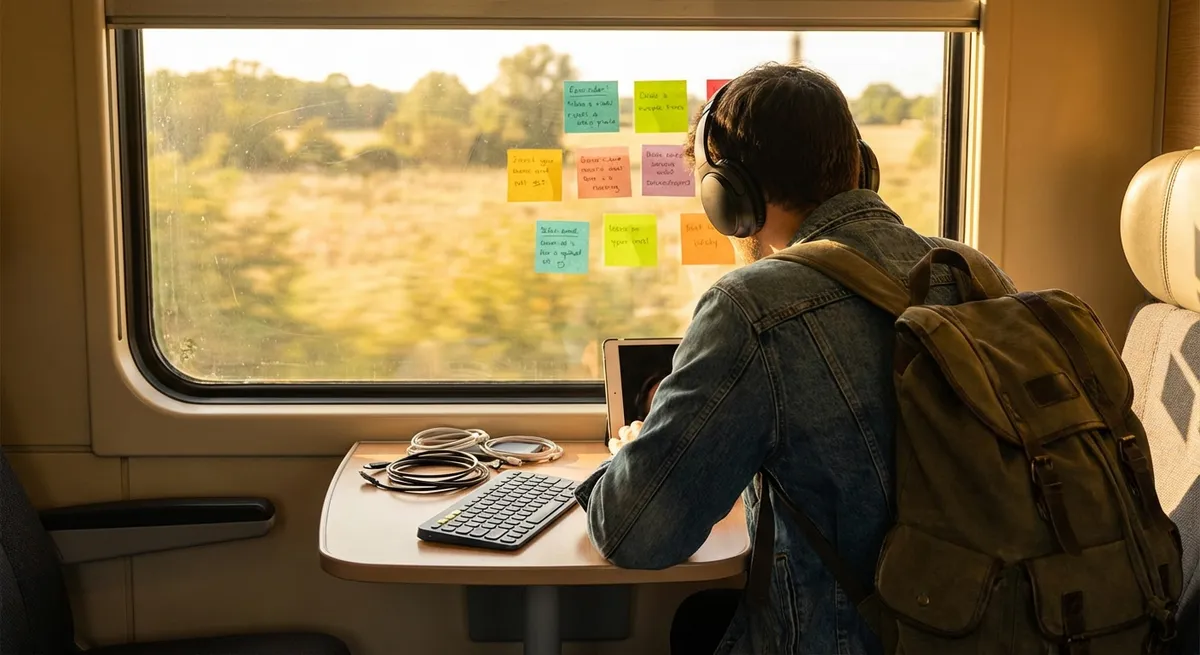
Being a digital nomad sounds like freedom, and sometimes it is. But once your backpack becomes your office and your days are split between client calls and bus stations, the romantic image wears off fast. What’s left is the reality: you either build systems that work everywhere, or you burn out and go home broke.
This isn’t about perfect aesthetics or Instagram reels. It’s about staying healthy, getting paid on time, and not losing your mind when the Wi‑Fi drops five minutes before a deadline. Below are five field-tested pillars to keep your nomad life sustainable instead of chaotic.
Treat Your Time Zones Like Gear, Not Background Noise
Time zones are not a detail; they are your infrastructure. Ignore them and you’ll miss calls, ship work late, and slowly lose trust with clients.
Start by locking in a “home base” time zone for all your professional communication, even if you’re moving. Tell clients, “All times in my calendar are in Eastern Time,” for example, and stick to it. Use tools like Google Calendar and World Time Buddy to avoid mental math, and add multiple time zones to your calendar view so you can see overlap at a glance.
Before booking a new destination, check how the time difference will affect your key work hours. A dreamy island that forces you onto a 1 a.m.–9 a.m. schedule for months isn’t worth it unless you’re deliberately choosing that lifestyle. If you’re juggling several clients in different regions, define your “protected hours” (for deep work and sleep) and offer very specific call windows instead of “I’m flexible.” Flexibility without boundaries quickly becomes unpaid overtime, especially when people assume you’re always available “because you work online.”
Finally, build a simple time-zone ritual for each move: update your calendar settings, adjust alarms, and send a short message to ongoing clients with your new local time and how that affects your standard availability. It takes five minutes and prevents countless misunderstandings.
Make Your Money Boring, Even If Your Locations Aren’t
Nomads don’t usually get taken out by adventure; they get taken out by cash flow and surprise admin. Your goal is boring, predictable money systems that work regardless of where your feet are.
Keep your banking stack simple and redundant. Use at least one globally recognized bank or fintech provider with low foreign transaction fees and good fraud protection, plus a backup card from a different provider. Store your emergency card separately from your main wallet. When (not if) one card gets skimmed or swallowed by an ATM, you won’t be dead in the water.
Run your income like a business, not a side hustle. Standardize your invoices, set clear payment terms (e.g., 50% upfront, remainder net 7 or net 14), and follow up consistently. Consider using invoicing tools that support multiple currencies and payment methods (bank transfer, card, PayPal, Wise, etc.) to reduce client friction.
Build a buffer that’s measured in months, not weeks. A common rule of thumb is at least three months of total living costs spread across easily accessible accounts. For nomads, six months is safer—border issues, health surprises, or a dry client spell are much harder to navigate when you’re on the road.
Lastly, know the basics of your tax obligations before tax season appears out of nowhere. Even a one-hour session with a tax professional who understands remote work can save you money and headaches. Nomad life feels independent, but revenue agencies don’t care that you’re “between countries” when they want their paperwork.
Choose Housing for Workflow, Not Just Instagram
Housing will quietly make or break your productivity. It’s tempting to chase views, but if your “office” is a wobbly table next to a noisy bar, your output will crater.
When you book a place, the non-negotiables are: reliable Wi‑Fi, a proper chair and table at workable height, decent lighting, and a reasonably quiet environment during your working hours. Message hosts before booking and ask direct questions: actual Wi‑Fi speed (request a screenshot of a speed test), whether the router is inside the unit, and how noisy it is during the day or night, depending on when you work.
Prioritize walkability to groceries, cafes, and a backup workspace like a coworking space or library. Every extra 20 minutes spent commuting for basic needs is 20 minutes not billing or resting. If you know you have a heavy project month, consider over-indexing on comfort rather than saving a few dollars on a cramped, dark room that saps your energy.
Treat your first week in any new city as “setup week.” Use it to map your life: where you’ll work if the Wi‑Fi dies, where you can print or scan if needed, where you’ll eat when you’re slammed, and where you’ll go to move your body (park, gym, pool). Nomad life gets exponentially easier once each new place has a clear “this is where I work, this is where I decompress, this is where I solve emergencies” plan.
Guard Your Health Like It’s Part of the Job (Because It Is)
You can push through one bad night’s sleep at home. On the road, that same lack of recovery layered on a 10-hour bus ride, new food, and mild culture shock is how people hit a wall.
Start with the basics you can actually control: sleep, movement, and food. Bring small, high-impact items like earplugs, an eye mask, and perhaps a compact travel pillow—these will help you steal quality sleep in noisy guesthouses and on red-eye flights. Lock in a minimum-movement standard you can meet nearly anywhere: bodyweight circuits, walking meetings, or a quick mobility routine you repeat daily.
Food-wise, aim for consistency, not perfection. In most places you can find a “default healthy-ish meal” (rice + protein + vegetables, simple omelet, etc.) and default to that several times a week to give your body something familiar. Constantly switching to heavy, greasy, or ultra-processed food, even when it’s cheap, will catch up to your energy levels and focus.
Health insurance is not optional. Look into travel-focused or international health insurance plans that clearly state what they cover: emergency care, hospitalization, evacuation, and routine visits. Before you arrive in a new country, learn the basics: emergency number, where the nearest reputable hospital or clinic is, and how payment works (cash up front, direct billing, etc.).
Remember: your body is the only piece of gear you can’t replace on the road. Treat recovery—sleep, downtime, simple routines—as a business asset instead of something you’ll “fix later.”
Build Work Routines That Survive Bad Wi‑Fi and Sudden Moves
Nomad life adds two variables to normal remote work: instability and uncertainty. Your routines need to survive flight delays, power cuts, last-minute border crossings, and guesthouse routers that randomly reset at noon.
First, separate work that requires strong, stable internet from what you can do offline. Before each travel day or stretch in a questionable location, prep offline tasks: drafting proposals, outlining articles, reviewing code, brainstorming, or planning. Download docs, emails you need to respond to, and reference material while you have good Wi‑Fi, then switch into “offline mode” when connectivity gets shaky.
Create a minimal daily workflow you can do almost anywhere: for example, a 10-minute planning session in the morning, 2–3 main work blocks, and a 10-minute shutdown routine in the evening. The specifics can flex with your time zone and schedule, but keeping the structure familiar helps your brain stay anchored when your environment keeps changing.
Always have a “Plan B” workspace and connection: a nearby coworking space, a quiet café with solid reviews for Wi‑Fi, or a local SIM with data so you can tether in an emergency. Learn how to use your phone as a hotspot and test it before you need it for a critical call.
Finally, keep your tools simple and portable. Cloud storage, password managers, and two-factor authentication that works even if you lose a phone or can’t receive SMS in a new country are essential. When you land somewhere new, test logins and tools early—finding out you’re locked out of your bank or main work platform five minutes before a client payment is due is not the kind of “adventure” you want.
Conclusion
A sustainable nomad life is less about hacks and more about boring, reliable systems you can carry from country to country. Time zones become part of your toolkit. Money flows in predictable ways. Housing choices support your work instead of sabotaging it. Your health is guarded, not treated as an afterthought. And your routines are sturdy enough to handle bad Wi‑Fi and sudden schedule changes.
The travel photos and stories are the visible part. What keeps you out there, earning and enjoying it, is mostly invisible: discipline, planning, and a willingness to treat this lifestyle like a real job with real constraints. Build that foundation, and your backpack really can be your office—for much longer than a single “gap year” experiment.
Sources
- U.S. Department of State – Country Information - Up-to-date safety, health, and entry information for countries worldwide
- Centers for Disease Control and Prevention – Travelers’ Health - Official guidance on vaccines, health risks, and preparation for international travel
- World Time Buddy - Widely used time zone converter and meeting scheduler for remote teams and travelers
- Wise – Guide to Sending Money Internationally - Practical overview of international transfers, fees, and multi-currency accounts
- Mayo Clinic – Sleep Tips: 6 Steps to Better Sleep - Evidence-based advice on improving sleep quality, crucial for frequent travelers
Key Takeaway
The most important thing to remember from this article is that this information can change how you think about Nomad Life.